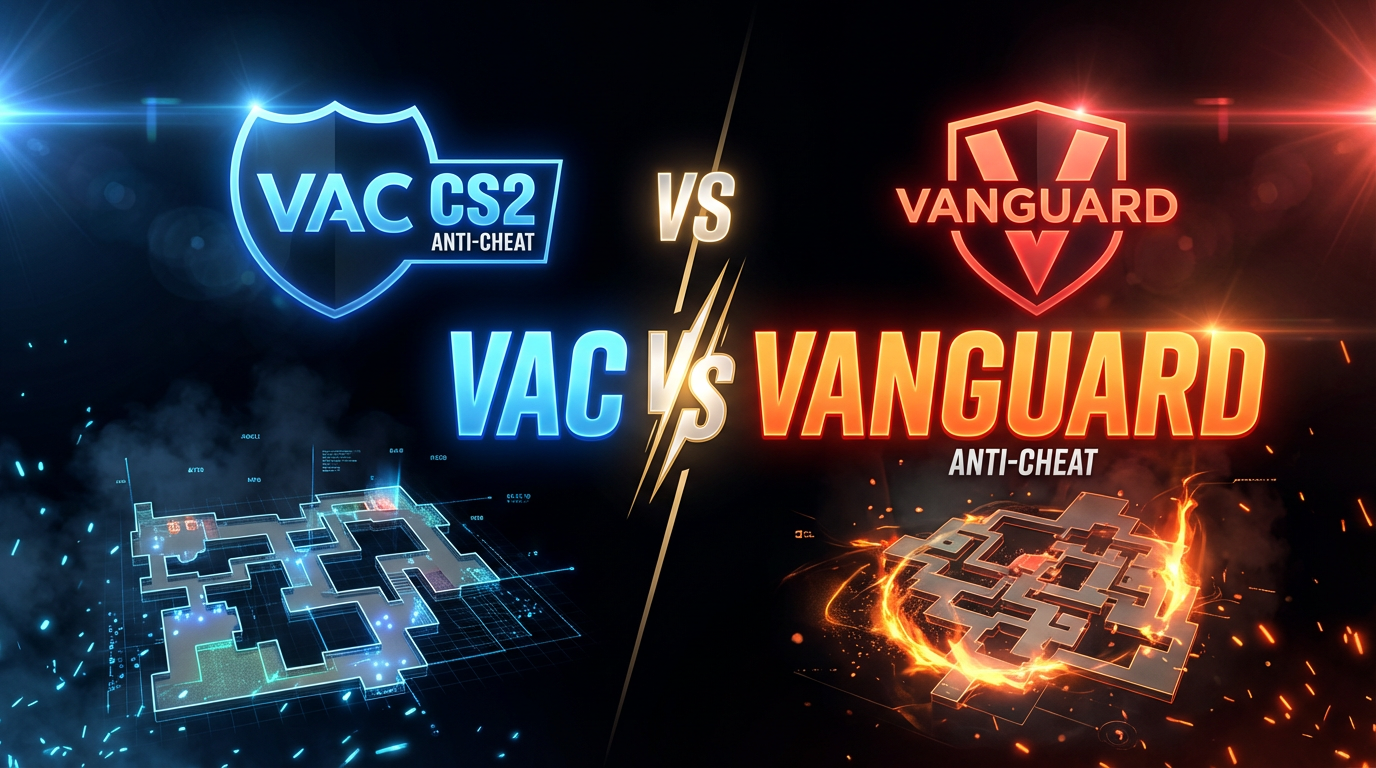
CS2 vs Valorant: Anti-Cheat Comparison (VAC vs Vanguard)
Two games, two completely different approaches to stopping cheaters. Here is a honest breakdown of how VAC and Vanguard actually work, where they succeed, and where they fall short.

0x3nn
Author
CS2 vs Valorant: Anti-Cheat Comparison (VAC vs Vanguard)
If you play competitive shooters, you have dealt with cheaters. It does not matter if it is a spinbotter in CS2 or a wallhacker in Valorant, the experience is miserable. Both Valve and Riot claim to have the solution, but their approaches could not be more different.
This is not a surface-level "which one is better" article. We are going deep into how VAC and Vanguard actually work, what they detect, what they miss, and what it all means for the average player.
The Fundamental Difference
Before we get into specifics, you need to understand one thing: VAC and Vanguard operate on completely different philosophies.
Valve Anti-Cheat (VAC) takes the passive approach. It runs as a user-mode process, collects data, and bans in waves. Valve does not want to touch your system more than necessary. They would rather let a cheater play for a few weeks and then ban 50,000 accounts at once.
Riot Vanguard takes the aggressive approach. It installs a kernel-level driver that loads when you boot your PC, not when you launch the game. Riot wants to prevent cheating before it happens, even if that means sitting in the deepest layer of your operating system 24/7.
Same goal. Completely different execution.
🔧 VAC: The Old Guard

How VAC Works
VAC has been around since 2002. It started as a basic signature scanner for Counter-Strike 1.6 and has evolved over two decades, but the core design philosophy has not changed much.
Here is what VAC actually does:
Signature Scanning
VAC maintains a database of known cheat signatures, things like specific byte patterns, DLL names, and memory structures. When you launch CS2, VAC scans your running processes and loaded modules against this database. If something matches, you are flagged.
Memory Analysis
VAC reads sections of game memory to check for modifications. If the game's code has been altered in ways that should not happen during normal play, VAC notices. This catches basic memory editors and simple injection methods.
Behavioral Heuristics (VACnet)
This is where things get interesting. Valve partnered with machine learning researchers to create VACnet, an AI system that analyzes gameplay demos for suspicious behavior. It watches things like:
- Aim snapping to heads through walls
- Statistically impossible accuracy rates
- Movement patterns that correlate with enemy positions
- Recoil patterns that do not match human input
VACnet does not ban players directly. It flags accounts for review and feeds data into Overwatch (Valve's community review system, not the game).
VAC's Strengths
- Low system impact. It runs in user-mode and does not mess with your drivers or boot process.
- Wave bans are devastating. When a ban wave hits, it takes out thousands of accounts simultaneously. Cheat developers cannot immediately tell what got detected.
- VACnet is genuinely impressive. The AI component catches things that traditional scanning cannot.
VAC's Weaknesses
- Delayed bans. A cheater can play for days or weeks before getting caught. That is weeks of ruined matches for everyone else.
- User-mode limitations. Because VAC does not operate at kernel level, any cheat that runs at Ring 0 is essentially invisible to it.
- Signature-dependent. If a cheat is private and its signature is not in the database, VAC will not catch it through scanning alone.
- No hardware bans by default. VAC bans are account-level. A cheater can just buy a new account and keep going. Phone number verification helps, but it is not a real solution.
🛡️ Vanguard: The Nuclear Option
How Vanguard Works
Vanguard launched with Valorant in 2020 and immediately caused controversy. Here is why: it installs a kernel-mode driver called vgk.sys that starts when your computer boots, before you even open Valorant.
Kernel-Level Driver (vgk.sys)
This is the big one. Vanguard operates at Ring 0, the same privilege level as your operating system kernel and hardware drivers. This gives it:
- Full visibility into every running process
- The ability to block unsigned drivers from loading
- Access to monitor system calls and memory at the deepest level
- Control over what software can run alongside Valorant
Boot-Time Initialization
Vanguard starts at system boot specifically so no cheat can load before it does. If a cheat loads before the anti-cheat, it can hide itself. By starting first, Vanguard ensures it has a complete picture of everything on your system.
Hardware Fingerprinting
Vanguard creates a detailed profile of your hardware:
- CPU, GPU, and motherboard serial numbers
- Disk identifiers
- MAC addresses
- BIOS information
- TPM data
This fingerprint is used for HWID bans. If you get banned, your entire PC is blacklisted.
Real-Time Behavioral Analysis
Like VACnet, Vanguard uses machine learning to analyze gameplay. But because it has deeper system access, it can correlate gameplay anomalies with system-level activity in real time, not after the fact.
Vanguard's Strengths
- Kernel access catches kernel cheats. If a cheat operates at Ring 0, Vanguard can actually see it. VAC cannot.
- Immediate detection potential. Vanguard can catch and prevent cheats in real time, not days later.
- HWID bans hurt. Banning hardware instead of just accounts makes cheating significantly more expensive and inconvenient.
- Driver blocking is effective. By preventing unsigned drivers from loading, Vanguard eliminates an entire category of cheat delivery methods.
Vanguard's Weaknesses
- Always running. The kernel driver is active from boot, even when you are not playing. Riot says it does not collect data when Valorant is closed, but the access is still there.
- System compatibility issues. The aggressive driver blocking causes conflicts with legitimate software: fan controllers, RGB utilities, overclocking tools, certain VPNs.
- Performance overhead. Some users report system slowdowns, especially on older hardware.
- Single point of failure. A vulnerability in Vanguard's kernel driver would be a massive security risk since it runs with the highest possible privileges.
📊 Head-to-Head Comparison

Let us break this down feature by feature:
Detection Speed
- VAC: Days to weeks. Wave-based banning means cheaters play free until the hammer drops.
- Vanguard: Minutes to hours. Real-time kernel monitoring enables much faster response.
Winner: Vanguard, by a significant margin.
System Intrusiveness
- VAC: Minimal. Runs in user-mode, only active during gameplay. You would not know it is there.
- Vanguard: Maximum. Kernel driver active from boot. Blocks other drivers. Always present.
Winner: VAC, if you value privacy and system control.
Ban Severity
- VAC: Account bans. Lose your skins and rank, but buy a new account and you are back.
- Vanguard: HWID bans. Your entire PC is flagged. New accounts get banned immediately.
Winner: Vanguard. Hardware bans are a real deterrent.
Effectiveness Against Public Cheats
- VAC: Good, but slow. Public cheats get signatured eventually.
- Vanguard: Excellent. Most public cheats are detected within hours of release.
Winner: Vanguard.
Effectiveness Against Private Cheats
- VAC: Poor to average. User-mode cheats with clean signatures can survive for months. Kernel cheats are essentially undetectable.
- Vanguard: Good but not perfect. Kernel-level cheats face a real opponent, but sophisticated DMA and firmware approaches still exist.
Winner: Vanguard, but neither is bulletproof.
False Positive Rate
- VAC: Very low. The wave system and manual review process means false bans are rare.
- Vanguard: Low, but higher than VAC. Aggressive heuristics occasionally flag legitimate software or unusual setups.
Winner: VAC, slightly.
What This Actually Means
Here is the reality that neither Valve nor Riot likes to talk about: no anti-cheat is unbeatable.
VAC is easy to bypass if you know what you are doing. Its user-mode design is a fundamental limitation that no amount of machine learning can fully compensate for. But it is also non-invasive and respects your system.
Vanguard is significantly harder to bypass, but it comes at the cost of having a kernel driver permanently installed on your PC. And even with all that access, determined individuals with the right tools and knowledge still find ways around it.
The honest answer is that both systems have made competitive gaming better than it would be without them. CS2 would be unplayable without VAC, and Valorant would be a disaster without Vanguard. But better is not the same as solved.
The Cheater's Perspective
We are not going to pretend this is purely an academic discussion. If you are reading this on Byteon, you probably want to know the practical implications.
For CS2:
- User-mode tools have a longer lifespan before detection
- No kernel driver to fight against
- HWID bans are not standard, reducing risk
- VACnet is the real threat, not signature scanning
- Playing smart matters more than having an undetected tool
For Valorant:
- The barrier to entry is significantly higher
- Only kernel-level, DMA, or firmware approaches have any real chance
- HWID spoofing is mandatory before every session
- Behavioral AI combined with kernel monitoring means you need both technical and gameplay discipline
- Public or semi-public tools have almost zero lifespan
At Byteon, our tools are engineered with these realities in mind. Our CS2 products leverage the user-mode environment while incorporating behavioral safeguards against VACnet. Our Valorant tools operate at the system level required to coexist with Vanguard, with built-in HWID protection.
Looking Forward
Both anti-cheat systems are evolving:
VAC is leaning harder into machine learning with VACnet 2.0 and expanding its behavioral detection. There are also rumors of optional kernel-level components for CS2 Premier matchmaking, which would be a significant shift in Valve's philosophy.
Vanguard is expanding hardware fingerprinting and improving its driver blocking capabilities. Riot is also integrating cross-game detection as they expand their game lineup.
The arms race continues. The tools get smarter, the anti-cheats get smarter, and the players in between deal with the consequences.
The Bottom Line
If you want a quick summary:
- VAC is the chill roommate who checks your stuff occasionally but mostly trusts you. Easy to live with, but easy to fool.
- Vanguard is the paranoid landlord who installed cameras everywhere and checks your ID at the door. Hard to trick, but exhausting to deal with.
Neither is perfect. Both are necessary. And understanding how they work is the first step to navigating either ecosystem intelligently.
Stay informed. Stay smart. And whatever you do, do not use free cheats.
For the latest tool status updates and compatibility info, check your Byteon dashboard or join our community. Stay safe out there.