External vs Internal Cheats: Which One Is Right for You?
External and internal cheats work in completely different ways, and picking the wrong type can get you banned before you even finish your first match. Here is everything you need to know before choosing.

0x3nn
Author
External vs Internal Cheats: Which One Is Right for You?
You see two cheats for the same game. One says "external," the other says "internal." They both promise aimbot, ESP, and all the usual features. Same price range. So what is the difference, and why should you care?
Turns out, the difference is massive. The type of cheat you pick directly affects detection risk, performance, feature depth, and how long you will actually get to use it before something goes wrong. Pick the wrong one for your situation and you are throwing money away.
Let us break it all down.
What Does "Internal" Actually Mean?

An internal cheat lives inside the game process. It gets there through injection — the cheat's code is loaded directly into the game's memory space using methods like DLL injection, manual mapping, or shellcode execution.
Once inside, the cheat has full access to everything the game knows. Player positions, health values, weapon data, bone structures for aimbot calculations — all of it is right there in memory, ready to be read and manipulated.
How Internal Cheats Work
The process usually goes like this:
- You launch the game normally
- The cheat loader waits for the right moment
- It injects a DLL or shellcode into the game process
- The cheat hooks into the game's rendering engine (DirectX, Vulkan)
- It reads game memory directly for player data
- Visuals are drawn inside the game's own render pipeline
Because the cheat is running inside the game, it can do things that are simply impossible from outside. It can hook the rendering engine to draw ESP overlays that move perfectly with your camera. It can read exact bone positions for pixel-perfect aimbot. It can modify game functions directly.
Internal Cheat Strengths
- Feature depth is unmatched. Smooth aimbot with bone selection, recoil control, skin changers, radar hacks, backtrack — internals can do it all because they have direct memory access.
- Visual quality is better. ESP boxes, health bars, and tracers are rendered inside the game engine itself, so they look clean and move perfectly with the camera. No flickering, no offset issues.
- Lower input latency. The cheat reads data from memory directly instead of going through external APIs or screen capture. Everything happens in real time with zero delay.
- More control over the game. Need to modify a specific game value? An internal cheat can write to memory, not just read it. This enables features like no-recoil, speed modifications, and other game-altering tweaks.
Internal Cheat Weaknesses
- Higher detection risk from injection. The act of injecting code into a protected process is exactly what anti-cheats look for. Vanguard, EAC, and BattlEye all monitor for injection attempts. If your loader gets signatured, you are done.
- Leaves traces in memory. Once injected, the cheat's code sits in the game's address space. Anti-cheats scan this memory for known patterns, hooks, and suspicious modules.
- Game updates break things. When developers push a patch, memory offsets change. Your aimbot was reading player health at offset 0x1A4? After the update it might be at 0x1B8. Internal cheats need constant updates to stay functional.
- Harder to develop and maintain. Building a stable internal cheat requires deep knowledge of reverse engineering, the game's engine, and anti-cheat internals.
What Does "External" Actually Mean?
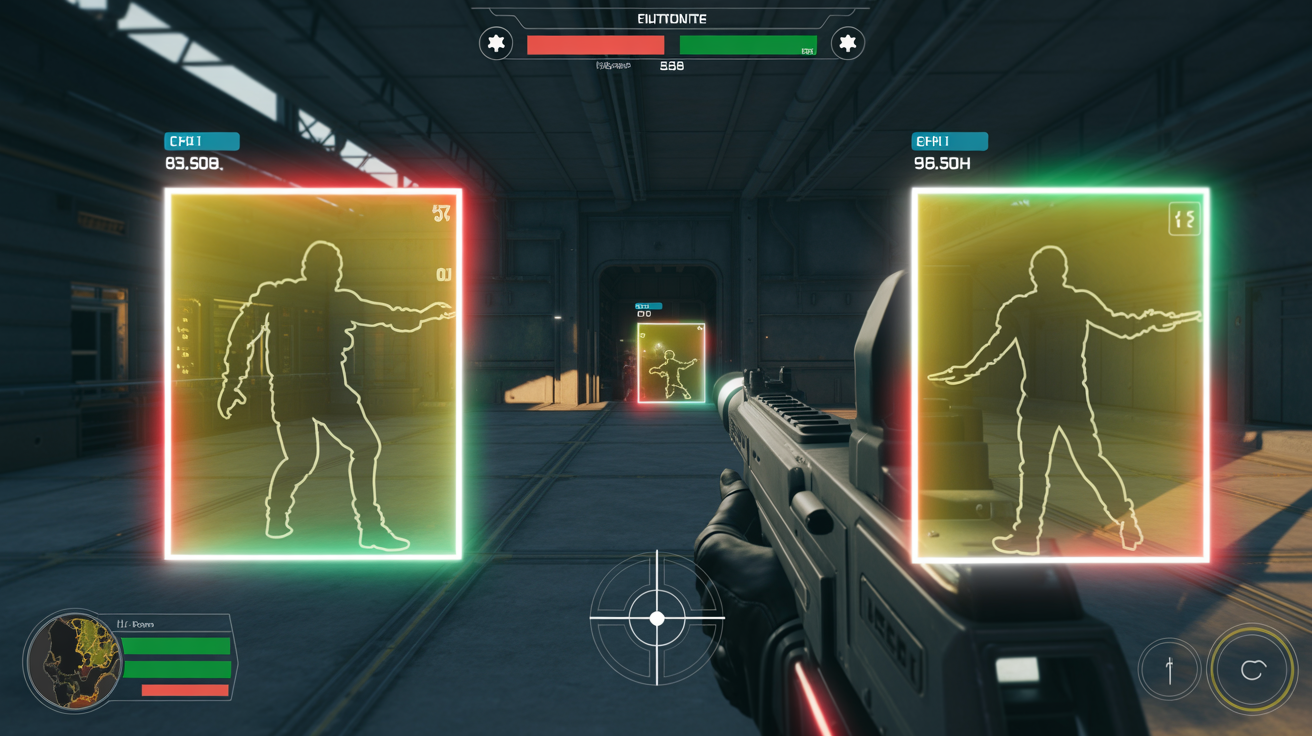
An external cheat runs as a completely separate process from the game. It never injects any code into the game's memory space. Instead, it reads game data from outside using system APIs like ReadProcessMemory, kernel drivers, or even hardware-based methods like DMA.
Think of it like this: an internal cheat is a spy who infiltrated the building. An external cheat is someone watching through the windows with binoculars.
How External Cheats Work
- The cheat runs as its own process (or kernel driver)
- It locates the game's process in memory
- It reads game data using external methods (RPM, driver-based reads, or DMA)
- Visuals are drawn in a separate overlay window on top of the game
- Input simulation happens through driver-level or hardware-level methods
The cheat never touches the game process directly. It observes from outside and acts through legitimate-looking system calls.
External Cheat Strengths
- No injection means fewer detection vectors. The biggest advantage by far. Since nothing is injected into the game, the anti-cheat cannot find your code by scanning game memory. You are not there.
- Survives game updates better. External cheats still need offset updates, but because they are not hooked into the game's rendering pipeline, they are generally more resilient to patches.
- Easier to keep undetected long-term. A well-written external cheat using a clean kernel driver can fly under the radar for months. The attack surface is simply smaller.
- Less crash-prone. Since the cheat is not sharing memory space with the game, a bug in the cheat does not crash your game. Worst case, the overlay disappears.
External Cheat Weaknesses
- Feature limitations. You can read memory, but writing is riskier and more detectable. Features like skin changers, backtrack, and certain aim modifications are either impossible or significantly harder to implement.
- Visual quality is lower. ESP and overlays are drawn in a separate window on top of the game. This can cause slight desync with camera movement, transparency issues, and sometimes flickering.
- Higher system overhead. Constantly reading another process's memory from outside is less efficient than reading it from inside. Some external cheats have noticeable FPS impact, especially on lower-end systems.
- Input methods are trickier. Simulating mouse movement for aimbot from outside the game requires driver-level input or hardware spoofing. Software-based input simulation is easily detected.
The DMA Factor

We cannot talk about external cheats in 2026 without mentioning DMA (Direct Memory Access). This is where things get really interesting.
A DMA setup uses a physical hardware card installed in your PC that reads memory through the PCIe bus. A second computer processes the data and displays the overlay on a separate monitor or feeds it back through a capture card.
Why DMA matters:
- The cheat runs on an entirely different computer
- No software on the gaming PC to detect
- Anti-cheats cannot see hardware reading memory through PCIe
- Even kernel-level anti-cheats have limited visibility into DMA reads
The catch:
- Expensive setup ($200-500+ for the hardware)
- Complex configuration
- Riot recently patched IOMMU pre-boot vulnerabilities specifically to combat DMA cheats
- Read-only by nature — no writing to memory, so features are limited to ESP and basic radar
DMA is essentially the most extreme form of external cheating. It moves the entire cheat off the target machine, which is both its greatest strength and the reason it costs significantly more.
📊 Quick Comparison Table
Here is the no-nonsense breakdown:
| Feature | Internal | External |
|---------|----------|----------|
| Detection Risk | Higher (injection is a red flag) | Lower (no code in game process) |
| Feature Depth | Full (aimbot, ESP, skin changer, etc.) | Limited (mostly ESP, basic aim) |
| Visual Quality | Excellent (rendered in-game) | Good (overlay can have minor issues) |
| Performance Impact | Lower (direct memory access) | Higher (cross-process reads) |
| Update Resilience | Low (breaks on patches) | Medium (more robust to changes) |
| Longevity | Shorter detection cycles | Longer undetected periods |
| Development Complexity | Very High | High |
| Price Range | $$-$$$ | $$-$$$$ (DMA setups cost more) |
So Which One Should You Pick?
There is no universal answer. It depends on what game you play, how you play, and what your risk tolerance looks like.
Go Internal If:
- You want the full feature set — smooth aimbot with bone selection, recoil control, skin changers, the works
- You are playing a game with weaker anti-cheat (CS2 with VAC, older BattlEye titles)
- You trust the provider to keep the cheat updated and undetected with fast response times
- You value visual quality and want clean, in-game rendered ESP
- You are okay with more frequent updates and occasional downtime after game patches
Go External If:
- Staying undetected long-term is your top priority
- You are playing a game with aggressive kernel anti-cheat (Valorant with Vanguard, newer EAC titles)
- You mainly want ESP and wallhack features rather than full aimbot suites
- You want something that is less likely to crash your game
- You are considering a DMA setup for maximum security
The Hybrid Approach
Some premium providers (including us at Byteon) offer products that blur the line. Our Valorant NewEra External, for example, operates externally but uses sophisticated kernel-level communication methods that give it feature depth closer to an internal cheat while maintaining the stealth advantages of external operation.
This hybrid approach is where the industry is heading. Pure internal and pure external are becoming less relevant as cheat developers find ways to combine the best of both worlds.
A Word on Safety
Regardless of which type you choose, some rules never change:
- Never use free cheats. They are either detected, contain malware, or both.
- Always use HWID spoofers before every session, especially on Vanguard-protected games.
- Do not rage cheat. The fastest way to get caught is not the cheat itself — it is playing like an obvious cheater. Behavioral detection is real and getting better every month.
- Keep your cheat updated. Running an outdated version after a game patch is asking for trouble.
- Use a dedicated setup if possible. Separate accounts, separate payment methods, separate hardware if you can manage it.
Final Thoughts
External and internal cheats are not "better" or "worse" — they are different tools for different situations. Understanding the technical differences puts you in a position to make smarter decisions instead of blindly picking whatever has the flashiest website.
The anti-cheat landscape is evolving fast. Kernel-level protection, AI behavioral analysis, and hardware-level security checks are making both approaches harder. But harder is not impossible, and the providers who understand these systems deeply are the ones keeping their users safe.
Choose wisely. Play smart. And do not cheap out on your tools.
Want to see our product lineup and find the right fit for your setup? Check out the products page or hit up our support team if you have questions.